Metal Detectors for Bakeries | BPS Bakery-Specific Solutions

Bakery-Specific Technology

Why Bakeries Require Specialized Metal Detection

Standard metal detectors designed for dry, low-conductivity products frequently fail when applied to baked goods — not because the equipment is faulty, but because baked goods present a fundamental physics challenge known as the product effect.

Baked goods contain moisture, dissolved salts, and sugars that make the product itself electrically conductive. When a standard metal detector generates its electromagnetic field through bread, cookies, crackers, or muffins, the product's conductivity produces a signal that can mimic or mask the signal from a metallic contaminant. The result: false rejects on good product, or — far worse — missed contaminants passing through undetected.

Product effect intensity varies by product type and composition:

Product Primary Effect Drivers Optimal Frequency Range
Sandwich bread, rolls High moisture, salt Low frequency (50–200 kHz)
Cookies & biscuits Sugar, chocolate inclusions Mid frequency (200–500 kHz)
Crackers & flatbreads Salt, low residual moisture Higher frequency (400–800 kHz)
Muffins & snack cakes High moisture, eggs, oil Low-to-mid frequency with phase adjustment
Frozen bakery items Residual moisture (frozen state) Mid-to-high frequency

The Cost of Getting It Wrong

A missed metal contaminant in a retail bakery product can trigger a full product recall, retailer delistings, FDA 483 observations, and significant brand damage. The average food recall costs a manufacturer over $10 million when all direct and indirect costs are included. Correct metal detector specification and calibration is the lowest-cost insurance policy a bakery can purchase.

Frequency Selection Is Critical

No single fixed frequency is optimal for all bakery products. Products with high product effect require lower operating frequencies to reduce sensitivity to the product's conductivity. This inherently reduces sensitivity to small contaminants — making multi-frequency simultaneous detection the engineered solution that eliminates this trade-off for bakery applications.

Temperature & Moisture Variability

Fresh-baked products exit ovens at elevated temperatures and moisture levels that drift downward as product cools on the line. A metal detector calibrated for room-temperature product will drift out of specification for hot-from-oven product. Auto-compensation and product-learning algorithms in BPS bakery detectors account for this thermal and moisture variance in real time.

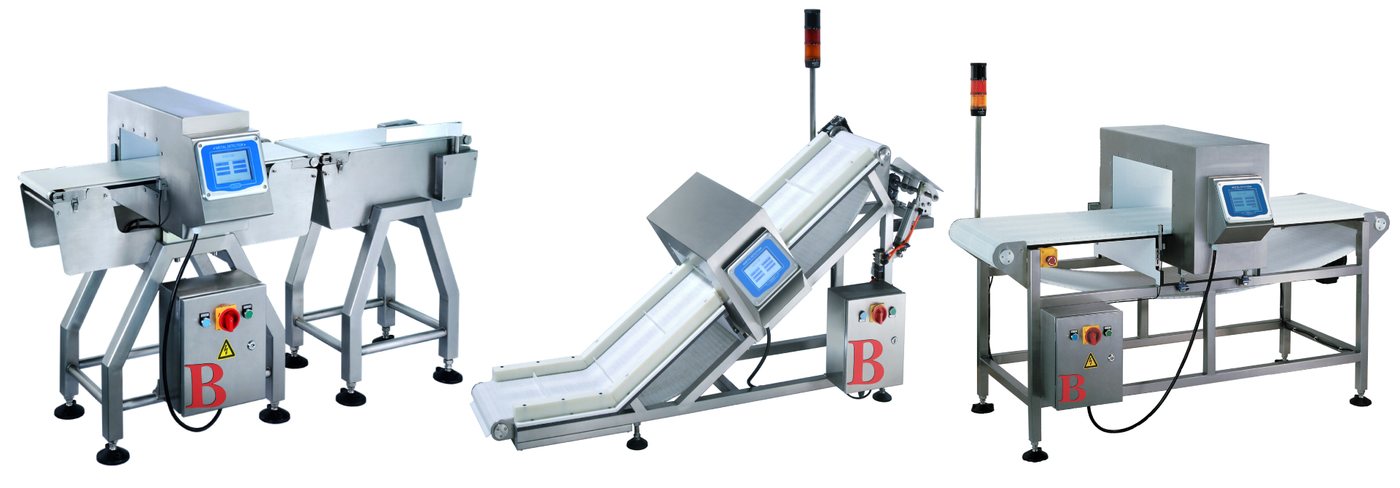
BPS metal detectors and check weighers lineup
Equipment Specifications

BPS Bakery Metal Detector Features

BPS bakery-specific metal detectors are engineered from the aperture coil through the reject mechanism to address the unique challenges of baked goods inspection. Every specification serves a purpose on the bakery floor.

Multi-Frequency Simultaneous Detection

BPS bakery metal detectors operate on multiple frequencies simultaneously — not sequentially. This allows the detector's digital signal processor to isolate the product effect signal from contaminant signals at the optimal frequency for each, achieving maximum sensitivity to ferrous, non-ferrous, and stainless steel contaminants without compromising detection by product effect. Ferrous sensitivity: ≤0.8 mm sphere; non-ferrous: ≤1.0 mm; stainless 316: ≤1.5 mm in typical wet bakery conditions.

Product Signal Suppression (Auto-Learn)

The auto-learn function passes a sample of the production product through the detector aperture — typically 20 to 50 pieces — and digitally maps the product's electromagnetic signature. Subsequent product passes are compared against this baseline; contaminant signals that deviate from the product profile trigger the alarm. Product profiles are stored by SKU and recalled instantly on changeover, eliminating manual re-calibration between product runs.

High-Speed Rejection Systems

Bakery lines running at 60 to 300+ packages per minute require rejection systems with response times measured in milliseconds. BPS bakery systems pair air-blast, pusher, or drop-gate reject mechanisms to line speed, product fragility, and package format. Rejects are directed to a locked reject bin with tamper-detection — mandatory under most retailer COP (Code of Practice) requirements and GFSI audit protocols.

Washdown IP Ratings

Bakery environments require daily wet cleaning and sanitization. BPS bakery metal detectors carry IP65 or IP69K ingress protection ratings — fully sealed against high-pressure wash water. Conveyor belts, belt tensioners, and frame components are constructed from 304 or 316 stainless steel with crevice-free surfaces that meet USDA, FDA, and 3-A Sanitary Standards criteria.

Touchscreen HMI & Data Logging

A full-color touchscreen HMI provides operators with real-time detection status, reject counts, and event logs. All metal detection events — including test-piece challenges — are time-stamped and stored in on-board memory with export capability to USB or networked quality management systems. Data integrity features prevent retroactive modification of records, a requirement under 21 CFR Part 11 for pharmaceutical applications and increasingly expected in food GFSI audits.

Quick-Release Belt & Tool-Free Changeover

For bakeries running multiple SKUs across different sizes and formats, rapid changeover is a production imperative. BPS bakery conveyors feature tool-free belt removal and re-tensioning for cleaning, product profile recall from the HMI for automatic sensitivity restoration, and height-adjustable frames to accommodate products of varying heights through the same aperture.

Regulatory Compliance

GFSI Compliance for Bakery Metal Detection

The Global Food Safety Initiative (GFSI) benchmarks a family of food safety management standards that major retailers and food service buyers now require of their bakery suppliers. Metal detection is a mandatory element of every GFSI-recognized scheme, and each scheme has specific requirements for how detection systems are implemented, verified, and documented.

SQF Level 2 & Level 3

Safe Quality Food Level 2 (Food Safety) and Level 3 (Food Safety + Quality) require that metal detection CCPs include documented sensitivity specifications, challenge test frequency (minimum per shift), corrective action procedures, and calibration records. BPS systems generate all required records automatically.

BRCGS Global Standard

BRC Global Standard for Food Safety (Issue 9) requires that metal detectors be validated for the specific product under production conditions, with contaminant sensitivity levels formally documented. Reject devices must include confirmation that rejected product cannot re-enter the production flow. Locked reject bins with tamper detection satisfy this requirement.

FSSC 22000

Food Safety System Certification 22000 integrates ISO 22000 with technical specifications PAS 220 (food manufacturing) and requires a validated HACCP plan with documented CCPs. Metal detection sensitivity must be validated under worst-case production conditions, and test records must be retained for a defined period per the site's FSMS document control procedure.

Retailer COP Requirements

Major retailers including Walmart, Costco, Kroger, and Whole Foods issue their own Codes of Practice that typically set minimum metal detection sensitivity thresholds (e.g., ferrous 1.5 mm, non-ferrous 2.0 mm, SS 2.5 mm) and require per-shift challenge test documentation. BPSG pre-configures systems and test protocols to satisfy the specific retailer requirements of each customer's buyer base.

BPSG Bakery Compliance Package

With 45 years of experience placing metal detection equipment in food manufacturing environments, BPSG delivers more than hardware. Our bakery compliance package includes:

  • Product-specific sensitivity validation testing with your actual product on your line
  • HACCP CCP documentation templates and sensitivity specification sheets for your food safety plan
  • Per-shift challenge test procedure written to your certification standard
  • Corrective action procedure for failed challenge tests and detected contaminants
  • Operator training for challenge test execution and record retention
  • Annual calibration service with calibration certificate for your audit file
  • Direct technical support line for audit preparation and troubleshooting

Full Specification Sheet

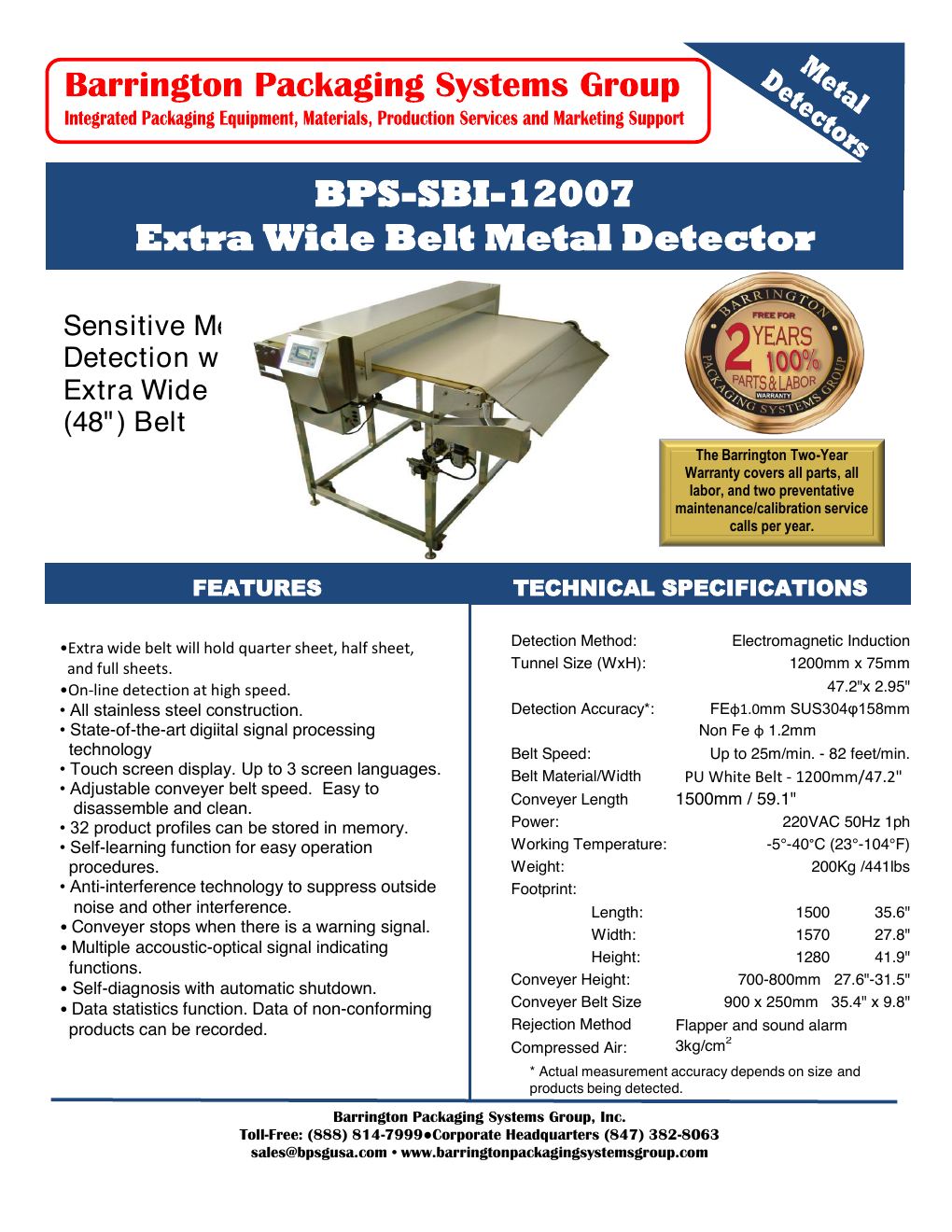
View or download the complete BPS Metal Detector for Bakeries spec sheet below.

BPS Metal Detector for Bakeries — Specification Sheet, page 1

Tap the page to open the PDF full size.

Download PDF Spec Sheet   Request a Quote