Metal Detector for Foil Packages | BPS Foil-Compatible Detection

The Core Technical Challenge

Why Standard Metal Detectors Fail with Foil Packaging

Metalized film, foil laminates, and aluminum packaging materials present the most technically demanding challenge in metal detection — because the packaging itself is electrically conductive. When a conventional metal detector passes its electromagnetic field through foil wrapping, the foil generates its own induced signal that saturates the detector's receiver coils, masking any signal from a contaminant inside the package.

The result: a conventional metal detector simply cannot distinguish between the foil packaging and a metallic contaminant within it. This forces manufacturers using standard detectors to either:

  • Reduce sensitivity dramatically — accepting higher minimum detectable contaminant sizes that may not satisfy food safety requirements
  • Inspect product prior to packaging — missing any post-pack contamination from the packaging operation itself
  • Switch to X-ray inspection — a significantly higher capital cost that also cannot detect all contaminant types

BPS foil-compatible metal detectors eliminate this compromise through phase-shift technology, enabling in-line inspection of foil-wrapped finished products at full production line speeds with sensitivity levels that satisfy HACCP CCPs, GFSI standards, and major retailer codes of practice.

How Phase-Shift Technology Works

Phase-shift (also called simultaneous multi-frequency or advanced signal processing) metal detection exploits a fundamental electromagnetic property: foil packaging and metallic contaminants produce signals at different phase angles relative to the detector's transmit frequency.
1
Signal Generation: The detector transmits a balanced electromagnetic field through a balanced coil set (transmit / two receive coils). In the absence of any conductive material, the receive coils are in perfect electromagnetic balance.
2
Foil Signal Mapping: When foil enters the aperture, it disturbs the balance — but at a consistent, learnable phase angle. The detector's DSP maps this phase signature and suppresses it via digital filtering, removing the foil signal from the detection window.
3
Contaminant Detection: A metallic contaminant within the foil package produces a disturbance at a different phase angle than the foil itself. The DSP identifies this phase-angle deviation and triggers the alarm and reject mechanism — regardless of the foil's presence.
4
Continuous Adaptation: Package-to-package variation in foil crinkle, folding, and overlap is accounted for by real-time signal averaging and adaptive filtering — maintaining detection sensitivity across the full production run without manual intervention.
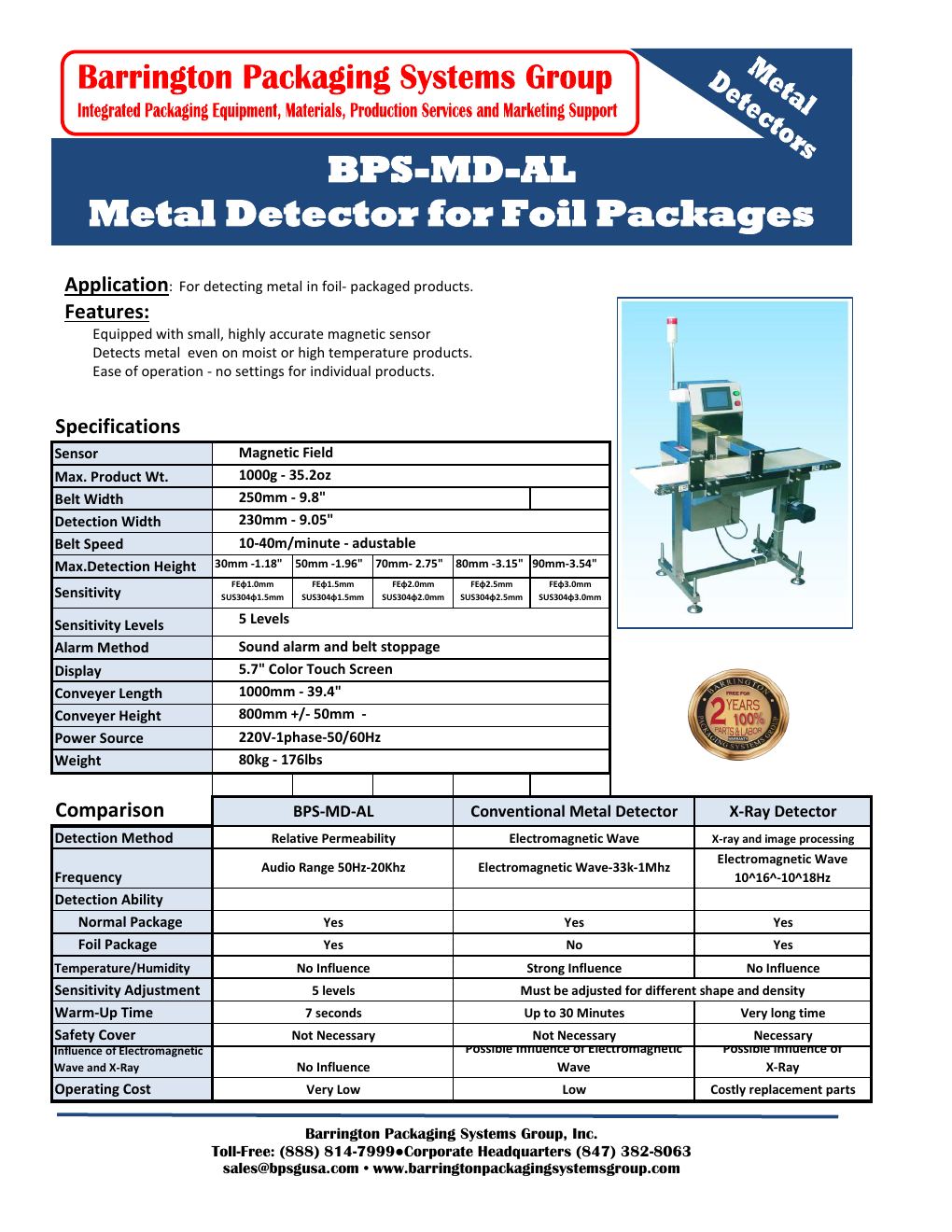
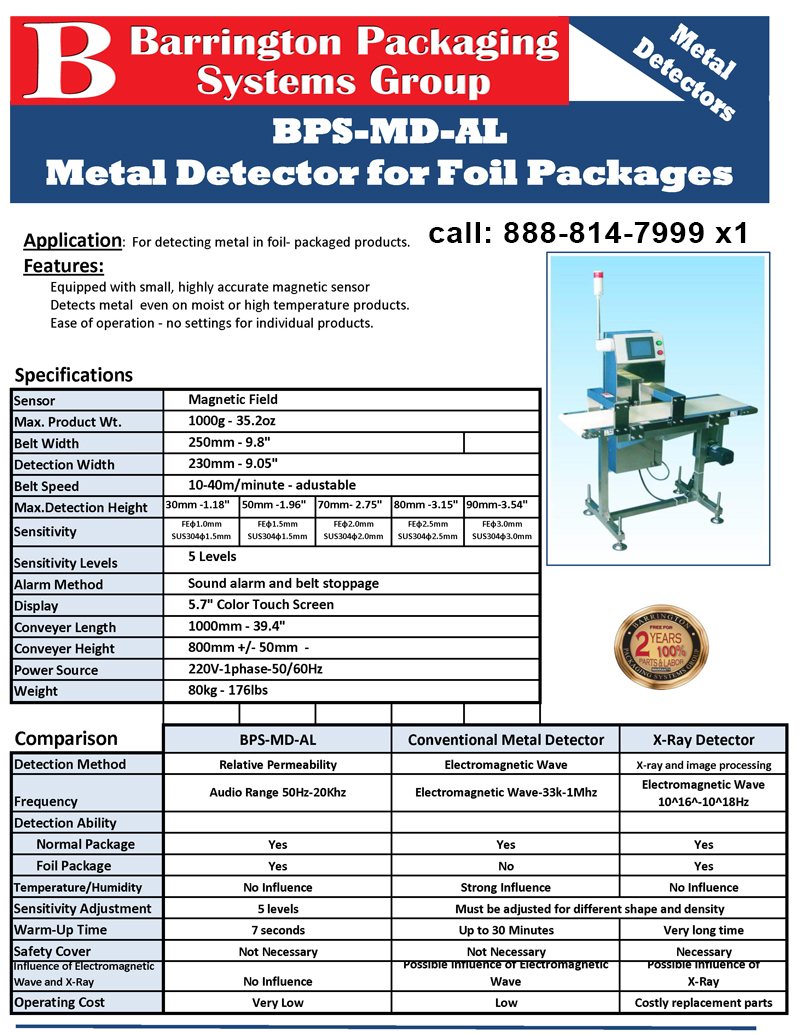
BPS-MD-AL metal detector for foil packages spec sheet
Technical Specifications

BPS Foil-Compatible Metal Detector Specifications

BPS foil-package metal detectors deliver industry-leading sensitivity in foil applications across food, confectionery, and pharmaceutical manufacturing environments.

Contaminant Type Sensitivity in Foil Wrapping Dry Product / Foil-Free Benchmark
Ferrous (carbon steel) ≤1.5 mm sphere ≤0.5 mm sphere
Non-ferrous (aluminum, copper, brass) ≤2.0 mm sphere ≤0.6 mm sphere
Stainless steel 316 ≤2.5 mm sphere ≤1.0 mm sphere
Wire (ferrous) ≤0.5 mm dia. × 15 mm ≤0.2 mm dia. × 8 mm
Wire (stainless 316) ≤0.8 mm dia. × 20 mm ≤0.3 mm dia. × 10 mm

Sensitivity values are indicative under standard conditions. Final sensitivity specifications are validated with the customer's actual product and packaging on the production line prior to commissioning. BPSG provides a written sensitivity specification report as part of every installation.

Foil & Metalized Film Formats Supported

  • Aluminum foil flow-wrapped candy bars and confections
  • Metalized BOPP / OPP flexible film pouches and wrappers
  • Foil laminate energy bars and protein bars
  • Foil-wrapped cheese portions and dairy products
  • Pharmaceutical blister packs (PVC/Alu and Alu/Alu)
  • Foil-lidded thermoformed trays (ready meals, deli items)
  • Twist-wrap foil confections and chocolate products
  • Foil-wrapped frozen food portions

Aperture & Frame Configurations

BPS foil-compatible tunnel detectors are available in aperture sizes from 100 mm to 500 mm wide and 40 mm to 200 mm tall — sized to match the largest package cross-section on your line while minimizing aperture area to maximize sensitivity. Larger apertures reduce sensitivity; BPSG engineers specify the tightest aperture that accommodates package variation on your specific line.

DSP Signal Processing

32-bit digital signal processing with simultaneous multi-frequency analysis. Automatic foil-signature mapping and suppression on product learn. Real-time adaptive filtering compensates for package orientation, foil crinkle, and edge effects.

IP65/IP69K Rated

Full washdown protection for food-grade environments. 304 or 316 stainless steel frame construction. FDA-compliant conveyor belts. Sealed electronics enclosure resists high-pressure wash water — no daily covers or protective procedures required during cleaning.

Product Memory Storage

Store up to 100 individual foil product profiles in on-board memory. Instant recall by SKU name at changeover. Each profile retains frequency selection, phase calibration, sensitivity thresholds, and reject parameters — eliminating per-run calibration time on repeat products.

Data Logging & Reporting

On-board event logging records every detection alarm, reject, and test-piece challenge with time stamp, product code, sensitivity reading, and operator ID. USB export and Ethernet connectivity for integration with plant QMS or ERP systems. Tamper-evident record protection.

System Integration

Integration Options for Foil Packaging Lines

A foil-compatible metal detector is only as effective as its reject mechanism and its integration with upstream and downstream equipment. BPSG designs complete inspection systems — not standalone detectors — ensuring every component of the detection and rejection process operates as a validated, auditable whole.

Reject Mechanism Options

  • Air-blast reject — for lightweight foil-wrapped products at high line speeds; pneumatic air nozzle diverts detected packages off the conveyor belt into a locked reject bin in under 50 ms
  • Pusher arm reject — for heavier or rigid foil-packaged products (e.g., foil-lidded trays, multi-bar cartons); servo-actuated arm sweeps contaminated product into a reject lane with positive confirmation feedback
  • Retracting belt reject — product is transported to the reject zone, belt retracts, and product drops into a locked bin below; zero product damage; ideal for fragile confections and pharmaceutical blister packs
  • Drop-gate reject — gravity-fed operation for high-speed gravity-fall applications upstream of packaging; low maintenance, minimal pneumatic requirements

Upstream Integration

BPS foil-detector conveyors integrate directly with HFFS flow wrappers, form-fill-seal machines, and hand-pack belts. Product spacing and conveyor speed are synchronized with the upstream machine's output rate. PLC or relay-based line stop signals halt upstream equipment on a reject, preventing product overlap in the aperture and protecting detection integrity.

Downstream Integration

After reject, confirmed-good product continues downstream to case packing, cartoning, labeling, or palletizing operations. Downstream conveyors, checkweighers, and labelers receive product-good signals from the metal detector controller to maintain line flow without gaps. BPSG coordinates integration wiring and PLC logic with your existing controls team.

Locked Reject Bin with Tamper Detection

All BPS rejection systems include a keyed, locked reject bin with tamper-detection sensor. If the bin lid is opened without an authorized key during production, the detector logs the event and can halt the upstream line. This closed-loop reject management satisfies BRC, SQF, and retailer requirements that contaminated product cannot be inadvertently re-introduced to the production flow.

Network & OPC-UA Connectivity

BPS foil detectors with Ethernet output connect to plant-level SCADA, OPC-UA, or proprietary QMS platforms. Real-time production metrics — pack rate, reject rate, sensitivity margin, and test-piece results — stream to factory dashboards. Integration with MES systems enables automatic batch-level quality record generation without manual data entry.

BPSG Application Engineering — 45 Years of Foil Line Experience

Correctly specifying a foil-compatible metal detector requires understanding the foil type, foil thickness, foil fold geometry, product dimensions, product conductivity, line speed, and target contaminant types. BPSG's application engineers have been solving foil-detection challenges for over 45 years. We conduct a pre-sale application review and provide a written specification recommendation before any equipment order is placed. Call 888-814-7999 to speak directly with our technical team, or submit your application details via our quote request form.

Full Specification Sheet

View or download the complete BPS Foil Package Metal Detector spec sheet below.

BPS Foil Package Metal Detector — Specification Sheet, page 1

Tap the page to open the PDF full size.

Download PDF Spec Sheet   Request a Quote